Shab-e-Yalda or Chella, has been considered as part of UNESCO’s Intangible Cultural Heritage (ICH). This was announced on the occasion of the 17th session of the intergovernmental committee for the safeguarding of Intangible Cultural Heritage held in Rabat, Morocco on 29 November 2022. The Islamic Republic of Afghanistan in 2016 made its efforts to nominate Yalda/Chella for the UNESCO’s Intangible Cultural Heritage. The process took more than five years to become part of the ICH.
In particular with relation to the 2003 Convention for the Safeguarding of the Intangible Cultural Heritage, Nowruz was inscribed as an element in 2009, and extended in 2016, on the Representative List of the Intangible Cultural Heritage of Humanity, at the joint initiative of Afghanistan, Azerbaijan, India, Iran (Islamic Republic of), Iraq, Kazakhstan, Kyrgyzstan, Pakistan, Tajikistan, Turkey, Turkmenistan and Uzbekistan.
Being part of UNESCO’s Intangible Cultural Heritage inscriptions means recognising the country’s heritage and its importance in maintaining cultural diversity in the face of increasing globalisation. Intangible Cultural Heritage means helping intercultural dialogue, fostering mutual respect for other ways of life. Its importance lies not in the cultural manifestation itself, but in the wealth of knowledge and skills that are transmitted through it from one generation to another.
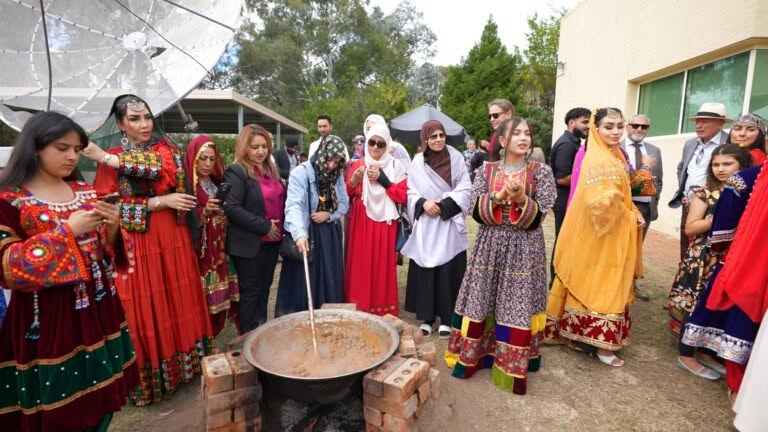
Yaldā/Chella refers to a traditional celebration of the sun and the warmth of life and is the longest night in thé solar calendar of Afghanistan that coincides wifh thé Qaus 30th (December 21st) of the Afghan solar calendar. It represents the last night of the autumn and the first day of the winter. This night embodies the victory of light over darkness, that is, the birth of Mitra which is the goddess of sun in the local beliefs. As of this night, days get longer and longer. In Afghanistan, people believe that the devil (Satan) invades houses at this night and they set fire at their houses to prevent entrance of evil and ugliness (embodied as the devil) to their houses.
Families gather at the houses of elders and sit around a table adorned with a series of symbolic objects and foods: a lamp to symbolize light, water to represent cleanliness, and red fruits such as pomegranates, watermelons, beetroots, jujube and grapes to symbolize warmth. Broth, sweets, dried fruits and nuts that are used specifically for the occasion are also set on the table and consumed during the gathering. Activities range from reciting poetry and storytelling to playing games and music and giving gifts to new in-laws, brides and children. The event celebrates cultural identity, nature, respect for women, friendship, hospitality, cultural diversity and peaceful coexistence. It is transmitted informally within families, although radio and television programmes, publications, social media and educational materials have also played an important role in transmitting the practice in recent years. Events, conferences, trainings, workshops and awareness-raising activities carried out by research centres, NGOs, cultural organizations and educational institutes have also had a significant impact on the proper transmission of the element to future generations.
For more information, please visit: https://www.unesco.org/en/articles/new-inscriptions-unesco-intangible-cultural-heritage