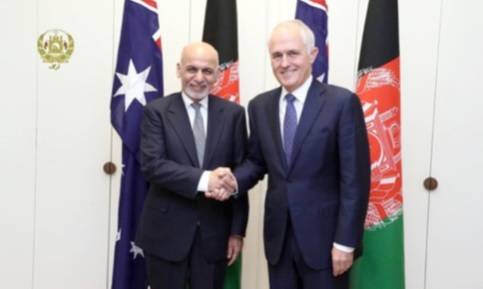
The MoU reaffirms the commitments made at the 2016 Brussels Conference on Afghanistan http://mfa.gov.af/en/page/the-brussels-conference-on-afghanistan including Australia’s commitment to maintain an $80 million aid program to 2020, and Afghanistan’s commitment to progress electoral and security reform, tackle corruption and uphold human rights, especially for women and children.
Australia is a long-standing partner to Afghanistan and has provided over AUD$1 billion in development assistance since 2001. Australia’s aid program in Afghanistan focuses on achieving three strategic objectives which are detailed in the DFAT Afghanistan Aid Investment Plan.
• Objective 1: Supporting the Afghan Government to maintain economic growth and institute more effective and accountable governance,
• Objective 2: Empowering women and girls by addressing barriers to their social, political and economic participation,
• Objective 3: Building resilience and supporting at-risk populations.
A new agreement between Geoscience Australia and the Afghanistan Ministry of Mines and Petroleum was also signed in April 2017 to strengthen scientific and technical cooperation in Earth Sciences to help advance the sustainable management of Afghanistan’s energy, mineral and water resources.
Soon after President Ghani’s visit, Prime Minister Malcolm Turnbull visited Afghanistan. Prime Minister Turnbull met President Ghani and Chief Executive Abdullah to discuss Afghanistan’s political and security outlook, and met Australian Embassy and Defence Force personnel working in Kabul.
25,000 Australian troops have served in Afghanistan since 2001, mainly in the Uruzgan province. 42 Australian soldiers have lost their lives in Afghanistan. Australia has extended its US$100 million annual commitment to the Afghan National Army and the National Police (ANP) until 2020. Australian commitment includes a US$80 million contribution to the Afghan National Army Trust Fund and a $20 million contribution to the Afghan National Police.
In December 2017, Afghan Deputy Foreign Minister Hekmat Khalil Karzai and Australian Deputy Foreign Minister Penny Williams co-chaired the first annual political consultation meeting between Afghanistan and Australia which was held in Canberra. The next annual political consultation meeting will be held in 2018.
The first Afghan-Australian Parliamentary Friendship Group was also inaugurated in December 2017 at the Australian Parliament House, Canberra. Liberal MP Andrew Wallace was selected to be the Chair of the group and Labor MP Julian Hill was selected to be Co-Chair. 24 Australian parliamentarians have registered as members of the group.
Throughout these official visits and the successive decades, the Australian-Afghan partnership has continued to grow, opening the way for new advancements for both states. In Afghanistan, projects to improve infrastructure and educational opportunities have flourished. Today, the Afghan Embassy in Australia and the Australian Embassy in Afghanistan are both dedicated to working closely with their respective governments in private and public sectors to further improve economic, military and technology relations between the two countries.
The current Afghan Ambassador to Australia, His Excellency Mr Wahidullah Waissi, presented his credentials to His Excellency General the Honourable Sir Peter Cosgrove, Governor-General of the Commonwealth of Australia, on 1 March 2017. Ambassador Waissi also serves as a non-resident Ambassador to New Zealand.