Embassy of the Islamic Republic of Afghanistan
Canberra - Commonwealth Australia
EMBASSY of
THE ISLAMIC REPUBLIC OF AFGHANISTAN
THE ISLAMIC REPUBLIC OF AFGHANISTAN
Canberra - Commonwealth of Australia
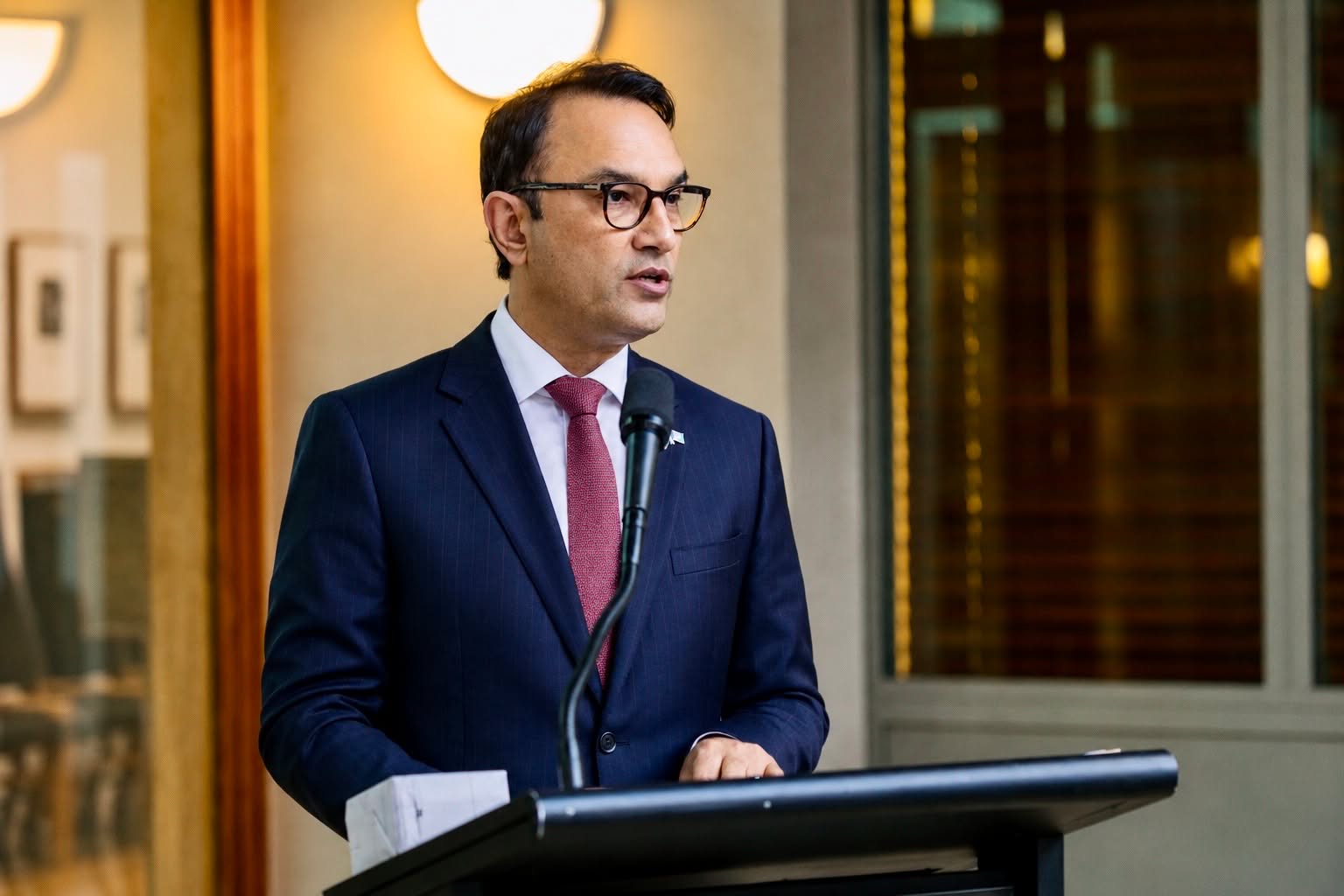
Transcript of HE Ambassador Waissi’s Speech at the Parliament of Australia
23 June 2026, Canberra
Dear Honourable Mr Speaker,
Hon Assistant Minister Thistlewaite,
Members and Senators,
Distinguished Guests,
Friends of Afghanistan,
Thank you for bringing us together today.
I am deeply honoured by this gathering and by the friendship that it represents.
I particularly wish to thank the Hon. Julian Hill MP, Dr Monique Ryan MP, and all members of the Parliamentary Friends of the People of Afghanistan for their leadership and commitment.
I am especially pleased that today’s gathering marks the relaunch of the Parliamentary Friends of the People of Afghanistan.
The choice of title is both thoughtful and important. Parliaments naturally engage with governments, but this is ultimately about people.
I also warmly acknowledge The Hon. Andrew Wallace MP, Member for Fisher, who served as Chair of the Parliamentary Friendship Group for Afghanistan during its formative years. I remain grateful for his friendship, support and goodwill towards Afghanistan and its people.
Governments may change, political circumstances may evolve, yet the people of Afghanistan remain.
At a time of immense challenge for Afghanistan, the continuation of this group reaffirms that the Australian Parliament’s interest in Afghanistan is not defined solely by events or governments, but by an enduring concern for the wellbeing, rights and aspirations of the Afghan people.
For that reason, I believe the Parliamentary Friends of the People of Afghanistan has an important role to play in the years ahead.
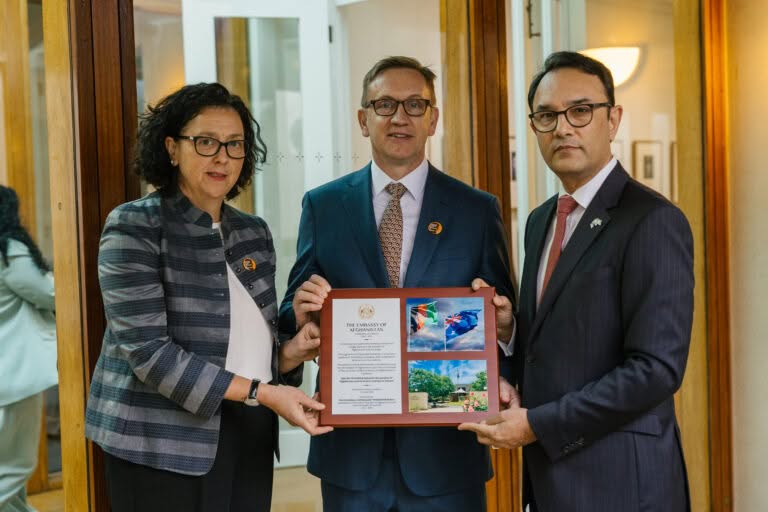
Before I continue, I would like to mark this occasion with two commemorative plaques.
Today’s gathering is not simply an event. It marks the relaunch of the Parliamentary Friends of the People of Afghanistan and comes at a significant moment in the history of the Embassy of the Islamic Republic of Afghanistan in Australia.
These plaques are not intended to honour individuals. Rather, they commemorate the enduring friendship between the people of Australia and the people of Afghanistan, and the role that this Parliament has played in sustaining that friendship.
It would be my honour to invite Julian Hill MP and Dr Monique Ryan MP to accept these plaques on behalf of the Parliamentary Friends of the People of Afghanistan.
Ladies and Gentlemen,
Today, I wish to speak not simply about the past, but about why Afghanistan still matters—to Australia, to our region, and to the world.
Afghanistan and Australia may appear distant from one another. Yet our histories have been connected for generations.
More than 160 years ago, Afghan cameleers helped open Australia’s interior, leaving a legacy that remains part of Australia’s national story today.
In more recent decades, our relationship has been strengthened through cooperation, through sacrifice and shared values.
Thousands of Australians—soldiers, diplomats, peace workers, aid workers and humanitarian personnel—served in Afghanistan, and many made profound sacrifices in support of the Afghan people.
Their contribution should never be forgotten.
History should remember that for twenty years Afghanistan was not merely a battlefield.
It was also a place of hope.
For twenty years, millions of Afghans experienced opportunities in education, media, civil society and public life that transformed an entire generation.
Young Afghans began imagining futures that their parents could scarcely have dreamed possible.
The Afghanistan of those years was imperfect. But it was moving forward.
Then came August 2021.
The collapse of the Republic and the return of the Taliban changed the course of our nation.
For millions of Afghans, it was not simply the fall of a government.
It was the collapse of a future they had spent two decades building.
Yet even in that dark moment, Australia stood by the Afghan people.
I wish today to express my profound gratitude to successive Australian Governments, both Coalition and Labor, to this Parliament, and to countless Australian officials who worked tirelessly during and after the evacuation effort.
Thousands of vulnerable Afghans found safety in Australia.
Many had worked alongside Australian institutions.
Many faced grave danger because of their commitment to democracy, human rights and international engagement.
Australia opened its doors and provided protection.
Australia provided hope.
Today many of those evacuees are becoming proud Australian citizens.
They are studying in Australian universities. Building Australian businesses.
Their success is one of the most enduring outcomes of Australia’s engagement with Afghanistan.
To all those who made that possible, I offer the sincere gratitude of the Afghan people.
Ladies and Gentlemen,
Today marks 1,773 days since Afghan girls were first banned from secondary education.
Think about that.
One thousand seven hundred and seventy-three days. Nearly five years.
Nearly five years during which millions of girls have been denied the simple right to enter a classroom.
Nearly five years during which young women have watched their dreams suspended.
Nearly five years during which an entire generation has been told that their aspirations matter less than their gender.
This is not merely discrimination. It is the systematic exclusion of women from public life.
It is the institutionalisation of inequality. It is one of the gravest assaults on human dignity taking place anywhere in the world today. It is also called Gender Apartheid.
The Taliban have not simply restricted women. They have attempted to erase them from public life.
They have dismantled rights of both men and women, silenced voices, suppressed civil society and governed through fear rather than consent.
The consequences extend far beyond Afghanistan’s borders.
No country can achieve stability while excluding half of its population. No society can prosper while suppressing education. No government can claim legitimacy while denying fundamental rights.
The question facing the international community is therefore not whether to engage with Afghanistan.
We must engage with the people of Afghanistan.
The real question is whether engagement should come at the expense of principle.
We must engage with the Afghan people without legitimising those who oppress them; provide humanitarian support without sacrificing our values; and stand consistently in defence of women and girls.
Australia has done this correctly so far, and for that, Australia deserves recognition.
Let me be clear.
The Afghan people and the Taliban are not the same thing.
Supporting Afghanistan does not require endorsing Taliban policies.
Humanitarian assistance does not require political recognition.
Engagement does not require normalisation.
The path to international legitimacy is not through diplomatic recognition.
It is through respect for human rights.
It is through accountability.
It is through allowing girls back into schools and women back into public life.
Until meaningful and verifiable change occurs, the international community should remain principled and united.
Ladies and Gentlemen,
Throughout these extraordinary years, I have had the privilege of serving the people of Afghanistan in Australia and New Zealand and Fiji
I have witnessed remarkable resilience.
I have met young Afghan-Australians excelling in universities, medicine, business, public service, sport and community leadership.
I have watched a community transform hardship into opportunity. The Afghan-Australian community today is one of the strongest bridges between our two countries.
I also wish to acknowledge those who stood beside me throughout this mission.
There are many of them — diplomats, locally employed staff, interns and volunteers — but here with us today are Mr Mostain Balagh, Mr Ateeq Zaki and Mrs Elfi Massey.
Each of them has served with dedication, loyalty and professionalism, and each has been a constant source of strength for the Embassy and for the Afghan community.
Ms. Massey alone has served the Embassy and the Afghan people for more than eighteen years.
Their commitment helped ensure that this Embassy continued serving people even during the most uncertain times. I am deeply grateful to them.
As many of you know, the Embassy’s operations will be suspended after 30th of June.
While the Embassy’s operations will be suspended after 30th of June, the needs of the Afghan community in Australia will remain. Matters relating to documentation, identity, family affairs and other consular services will continue to affect thousands of individuals and families. I am confident that, through goodwill and cooperation, practical arrangements can be found to ensure these needs continue to receive appropriate attention.
The friendship between Australia and the people of Afghanistan remains important.
Perhaps now more than ever.
That is why I am pleased to share that the next chapter of my work and my colleague’s will be through a newly established, The Afghanistan Institute.
The Institute is founded on a simple belief.
Afghanistan should be understood through knowledge rather than stereotypes.
Through scholarship rather than slogans.
The Institute will promote knowledge, dialogue and understanding of Afghanistan while strengthening people-to-people links between Australia and the Afghan people.
It will serve as a bridge between Australia and the Afghan people.
A place where knowledge, evidence and understanding can continue to flourish.
Because while political circumstances may change, the need to understand Afghanistan remains.
Indeed, in today’s increasingly uncertain world, it is more important than ever.
Ladies and Gentlemen,
The story of Afghanistan is often told through the language of war.
But Afghanistan is more than war.
It is a civilisation. It is poetry. It is culture. It is resilience. And above all, it is people.
People who continue to hope and to learn. People who continue to dream of a better future.
History teaches us that repression is never permanent. Fear is never permanent.
The denial of freedom is never permanent.
The aspirations of a people cannot be imprisoned forever.
And the aspirations of Afghan women and girls will ultimately prevail. Because every day they continue to prove their resilience to the world.
• In the underground classrooms of Afghanistan, they are denied but continue to pursue.
• In the careers they are forbidden from entering but continue to prepare for.
• In the mountains they climb, the fields they play on, and the dreams they refuse to surrender.
We saw it last month when Melbourne-based mountaineer River Ahmad became the first Afghan-Australian woman to summit Mount Everest.
We see it in Afghanistan’s women cricketers, who rebuilt their lives in Australia and continue to represent the hopes of millions of Afghan girls. They are now in London and preparing for the matches.
And we see it in Afghanistan’s Australia based women soccer team in exile, whose recent recognition by FIFA stands as a powerful affirmation that exclusion can delay opportunity, but it cannot erase it.
These women are not merely athletes. They are symbols of hope.
Before I conclude, I wish to thank this Parliament.
I wish to thank the Australian Government and the Australian people.
And I wish to thank every Australian who has stood beside Afghanistan during difficult times.
Your solidarity has mattered. Your friendship and your principles have mattered.
The future of Afghanistan remains uncertain. But one thing remains clear.
The Afghan people have not given up.
And neither should the world.
Thank you.
About Embassy
The Embassy of the Islamic Republic of Afghanistan in Canberra – Australia, serves as a diplomatic mission representing Afghanistan. It provides a range of consular services to Afghan citizens and residents in Australia, including passport renewals, visa applications for foreign citizens, and legal affairs.
The Embassy of Afghanistan in Canberra operates autonomously and independently from the Taliban’s control or influence after 15 August 2021.
The Embassy of Afghanistan in Canberra operates autonomously and independently from the Taliban’s control or influence after 15 August 2021.
Consular Affairs
Contact Details
Address:
4 Beale Crescent
Deakin West ACT 2600
Postal Address:
PO Box 9553
Australia Post - LPO Deakin
4 Duff Place, Deakin ACT 2600
Telephone:
+61 2 6282 7377
4 Beale Crescent
Deakin West ACT 2600
Postal Address:
PO Box 9553
Australia Post - LPO Deakin
4 Duff Place, Deakin ACT 2600
Telephone:
+61 2 6282 7377
Need More Information?